
Masquerades of the Kankurang Tradition
The word Kankurang is believed to derive from the Mandinka words kango (voice) and kurango (to enforce), reflecting its traditional role as a guardian of moral order and communal discipline. Across Mandinka communities, the Kankurang has taken many forms, shaped by local materials, histories, and customs.
While numerous masked traditions are commonly referred to as Kankurang, Mandinka oral history identifies three original Kankurang forms from the Manding region. According to knowledgeable elders and historians, these three are regarded as the foundations from which other variations later developed.
The masquerades presented below introduce these three principal Kankurang traditions, whose symbolism and costumes continue to influence Kankurang expressions across The Gambia and the wider region.
Jamba Kankurang
Recognised as one of the earliest Kankurang forms, Jamba Kankurang is closely associated with authority, protection, and discipline within Mandinka society. Traditionally distinguished by its use of bark fibres and mahogany leaves, its face, arms and legs painted with natural pigments, Jamba Kankurang embodies a strong connection to the forest and ancestral law.
It is the mostly common in Janjanbureh but will now be seen throughout the country as a purely entertainment function


Faraa Kankurang
(Wuleng Wulengo / Ifangbodi)
Often associated with myth and spiritual presence, Faraa Kankurang, also known as Wuleng Wulengo or Ifangbodi, carries a more mystical identity within the Kankurang tradition. Elders describe it as one of the original forms brought from Manding, with costumes and performance styles that emphasise otherworldly power and transformation.
Its costume is made out of jaffo/bark covering the entire body and often carries two machetes.
Known also as The Flying Kankurang because of its rapid movements, it is traditionally heard at night and seen high up in tall trees protecting circumcised children from evil spirits.
Jamba Jabally Kankurang
Jamba Jabally represents the third of the original Kankurang traditions, recognised for its distinctive costume and performance character. Like the other principal forms, it is rooted in initiation practices and communal regulation, though its appearance and materials vary according to locality.

Here it is dressed completely in mahogany leaves and sings with a chorus of women.
The word Jambajabally means
'Leaf's never dry' meaning it is only out for a short period.
It is most common in Jimara and Wuli districts, Upper River Region,
but also found in the Central River Region.
Voices from Janjanbureh
The late Hon. Foday Manka, a respected historian from Janjanbureh, explained that the masks worn by the Kankurang conceal the wearer’s identity in order to depersonalise their actions. In doing so, the mask removes individual authority and places responsibility beyond the ordinary person.
He compared this function to the robes worn by judges of the Supreme Court: just as a judge’s gown represents the authority of the law rather than the individual, the Kankurang’s mask signifies that no ordinary person has the right to judge another. Instead, the masked figure is understood to act in the name of the spirit, carrying a form of authority believed to be superhuman.
Related Masquerade Traditions
While the Kankurang is rooted in Mandinka tradition, the Janjanbureh Festival also welcomes other masquerade cultures of The Gambia and the wider region,
reflecting the country’s rich and shared heritage.
Zimba

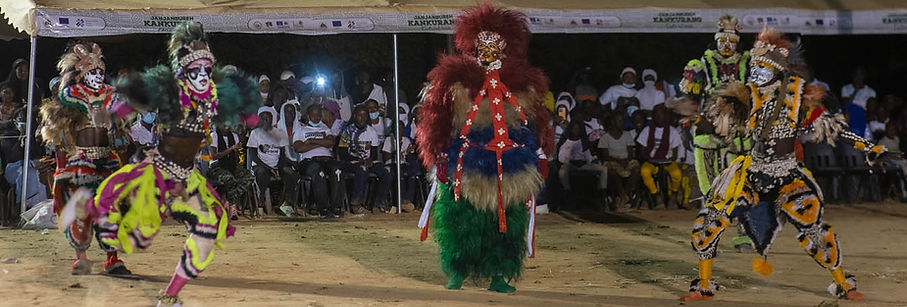
Zimba is one of the most popular masquerades associated with Wolof tradition and is commonly seen in urban areas of The Gambia and Senegal.
It is often referred to as the “Lion Dance Mask,”

Visually, Zimba is especially striking for its strong lion-like form, with the main masquerade characterised by heavy fur and powerful movement. The colour and visual complexity come largely from the accompanying male singers and performers, whose face painting, costumes, and energetic choreography heighten the spectacle and intensity of the performance.
From the Jola/Diola Regions
The Essame and Kumpo
Essamaye
If you attend a wrestling match you often see the Essamaye and at important social occasions such as weddings, initiations, and naming ceremonies.

It is considered the mother of all other masks.
The masquerade animates events through energetic movement accompanied by singing and clapping, and is traditionally attended only by circumcised youth.
The mask is recognised by its striking features — a long neck, round eyes, and an open mouth resembling that of a crocodile — giving it a powerful and fearsome presence. Essamaye never appears alone; it always emerges alongside Kumpo, reinforcing their close ritual relationship.
Essamaye never appears alone; it always emerges alongside Kumpo,
reinforcing their close ritual relationship.
Kumpo
Made entirely from shredded palm fronds, ropes, and sticks, Kumpo reflects the deep connection between Jola culture and the palm tree, a vital resource for everyday life. The masquerade is accompanied by drumming and clapping, moving rhythmically while producing guttural sounds that add to its commanding presence

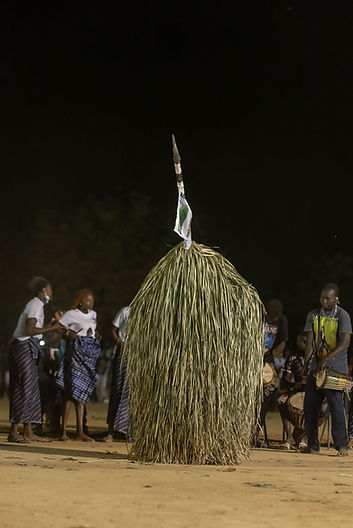
Its form is distinctive: a towering whirl of palm fibres balanced around a central pole, creating a powerful spinning motion during performance.
Aku Masquerade Traditions
The festival also reflects the heritage of the Aku community, descendants of formerly enslaved people who returned to The Gambia and settled primarily in urban areas.
Aku masquerades draw on different historical experiences and expressive forms, adding further richness to the festival’s cultural landscape.
Both the Hunting Devil and The Fairy are representatives of the Akus.
Hunting Devil

Among the Aku community, masquerade traditions are closely linked to Christian festivals and celebrations, and thus, do not appear during Lent.
The Hunting Devil reflects this context, functioning primarily as a performance tradition rather than a ritual one.
The masquerade’s head may feature horns or representations of a wide range of animals, while the costume is often made from recycled jute sacks.

Carried on the back is a large central calabash, decorated with objects gathered from the bush and palm leaves, which are understood to symbolise Christian identity and belief.
The Hunting Devil is accompanied by members of the community who sing and clap rhythmically, often using wooden clappers, creating an energetic and participatory atmosphere that draws the audience into the performance.
The Fairy
The Fairy originated in Ghana (formerly the Gold Coast) and later introduced to The Gambia by Sierra Leonean immigrants during the 1950s and 1960s.
Today, it is most commonly seen in urban areas such as Banjul and Serrekunda, where it appears prominently during Christian festivals, especially Christmas Day, and never during Lent.


Unlike more fearsome masquerades, the Fairy is characterised by elegance, colour, and theatrical movement. Earlier accounts suggest that costumes once incorporated natural, shimmering materials to create a striking visual effect. With access to modern materials, performers now use a wide range of glittering fabrics and decorative elements, enhancing the Fairy’s luminous appearance and sense of spectacle.
Its presence reflects the creative expression of the Aku community and highlights the diversity of masquerade traditions that contribute to The Gambia’s cultural landscap
Koyangi (Local Masquerade Tradition)

The costume is characterised by layered fibres, wrapped limbs, and attached objects, creating a powerful physical presence. Koyangi is typically encountered in motion — moving through crowds as part of the wider festival atmosphere — rather than as a staged performance.
Koyangi is a lesser-documented masquerade form that appears during festival processions and community celebrations. While limited written information exists, its continued presence reflects the richness of local masquerade traditions that are passed down through practice rather than formal record.

Its inclusion in the Janjanbureh Kankurang Festival highlights the importance of recognising living traditions, including those whose meanings are held within communities and expressed through action rather than text.

